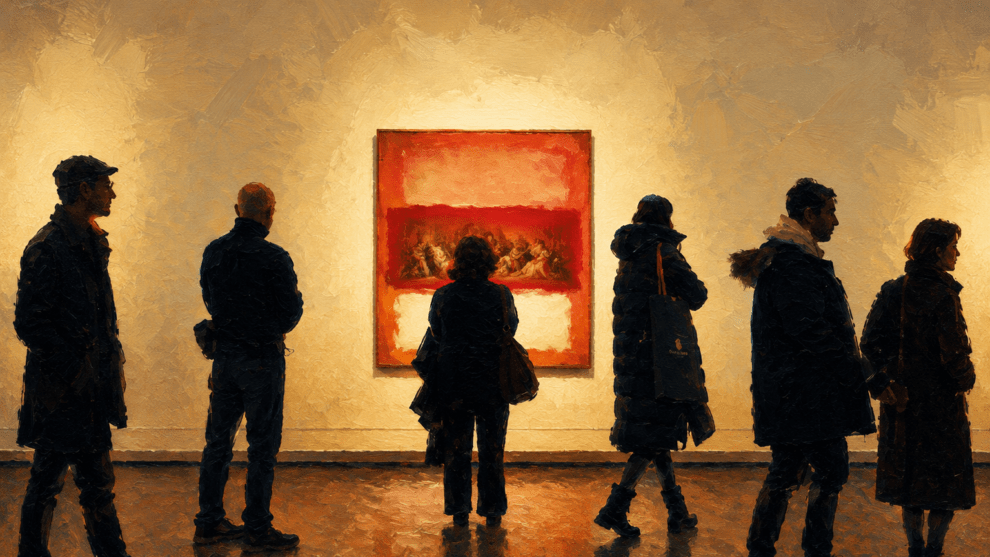
Art has always evolved with technology. From cave walls to canvas, from photography to digital rendering, each shift has expanded how we create and consume visual expression. Today, digital art, accessible through screens, platforms, and even blockchain ownership it has reached unprecedented scale. The question, however, is not whether digital art is valid, but whether it can truly replace the experience of standing before a work in a gallery.

Access vs Presence
Digital art has fundamentally changed access. A viewer in one part of the world can explore exhibitions across continents in seconds. Artists no longer depend solely on galleries or institutions; they can publish, promote, and monetize their work independently.
This accessibility is powerful. It has opened doors for new voices, new formats, and new audiences. But in doing so, it has also altered the way art is consumed. Digital viewing often happens in passing between messages, notifications, and endless scrolling. Art becomes part of a feed, rather than the focus of attention.
In contrast, galleries demand presence. They require time, movement, and intention. And that difference is more significant than it first appears.
The Experience of Scale, Texture, and Space
A painting on a screen is not the same as a painting on a wall. Scale alone changes perception. What appears subtle on a phone may feel overwhelming in person. Texture, depth, and materiality with brushstrokes, layers, imperfections which are often lost in digital translation.
Galleries also shape how art is experienced. Lighting, spacing, and silence are not incidental; they are part of the design. They guide the viewer’s eye, control the pace, and create a sense of immersion.
Standing in a gallery, art becomes more than an image. It becomes an environment, something you move through, rather than simply observe.

Authenticity and Emotional Connection
There is also a deeper, less tangible distinction: authenticity. Viewing an original artwork carries a sense of connection—not just to the piece, but to its creation. The time, effort, and human touch embedded in the work become part of the experience.
Digital art challenges this idea. It is infinitely reproducible, and while systems like NFTs attempt to establish ownership, the experience remains fundamentally different. You may own a version, but you are still viewing it through a screen.
Emotionally, too, galleries offer something unique. They create moments of stillness. Away from distractions, viewers engage more deeply, often forming personal interpretations that feel more immediate and lasting.
Coexistence, Not Replacement
None of this diminishes digital art. In many ways, it represents the future which is interactive, dynamic, and unconstrained by physical limits. It allows artists to experiment in ways traditional mediums cannot, and it brings art to audiences who might never step into a gallery.
But replacement is not the same as evolution.
Digital art excels in reach and innovation. Galleries excel in depth and experience. One expands art outward; the other draws the viewer inward.
The future is likely to be hybrid, where digital platforms enhance discovery, and physical spaces deepen connection. Each serves a different purpose, and together they broaden what art can be.
More Than Just Seeing
Ultimately, art is not only about visibility, it is about presence.
Screens can display art with clarity and convenience. But they cannot fully replicate the quiet, immersive moment of standing before a work where time slows, distractions fade, and the experience becomes entirely your own.
And it is in that moment that art truly lives.