1. You work with digital evidence every day. In your experience, what is the biggest misconception judges, lawyers, or even the public have about digital proof in court?
A common misconception about digital evidence is that it is either infallible or fundamentally unreliable. In truth, it is neither. Digital evidence is only as strong as the process used to collect, preserve, and present it. Technology does not guarantee accuracy; methodology does.
When digital material is gathered properly—maintaining a clear chain of custody, following forensic protocols, and ensuring that the data remains untampered—it can be highly probative and immensely valuable in court. Metadata, timestamps, device logs, server records—these can reconstruct timelines and establish connections with remarkable precision. But that reliability depends entirely on discipline.
If the collection process is flawed, if documentation is incomplete, or if preservation standards are not strictly followed, even the strongest digital material can lose credibility. A single break in the chain of custody can raise reasonable doubt.
So the debate should not be about whether digital evidence is trustworthy in itself. The real question is whether the professionals handling it are trained, methodical, and accountable. The strength of digital evidence ultimately lies not in the technology, but in the integrity of the process that surrounds it.

2. Digital evidence can be changed, deleted, or manipulated very easily. What are the main weaknesses you see in how digital evidence is collected and protected in Bangladesh?
The primary gaps we face are procedural, not technological. In many cases, the tools are available—but the consistency in applying proper protocols is where weaknesses emerge. Standardized seizure procedures, correct forensic imaging practices, and meticulous documentation must be followed every time, without exception. Even small deviations can undermine the credibility of otherwise strong evidence.
Equally critical is what I would call courtroom literacy. Digital evidence can be highly technical, and unless judges and lawyers are equipped with clear, accessible explanations, its value may not be fully appreciated. The responsibility lies with prosecutors and forensic experts to translate complex technical findings into language the court can confidently rely on.
Strengthening institutional capacity—through training, standardized procedures, and interdisciplinary coordination—will go a long way in enhancing trust in digital evidence. When process and understanding improve, evidentiary confidence improves as well.
3. Cyber threats are evolving fast — ransomware, online fraud, deepfakes. Which threat do you think Bangladesh is least prepared for right now?
The rapid rise of AI-generated synthetic media has introduced a serious strategic challenge. Deepfakes and manipulated digital content are no longer futuristic concerns—they are immediate risks. A convincingly altered video or fabricated audio clip can spread within hours, influencing public opinion, disrupting financial markets, or even undermining electoral processes. The speed and scale at which such content travels make the threat particularly acute.
Addressing this challenge requires more than technical awareness. It demands coordinated legal reform to define and regulate malicious use, stronger forensic capabilities to detect and authenticate digital material, and sustained international cooperation. Synthetic media does not respect borders; neither can our response.
If we are to safeguard democratic institutions, financial stability, and social cohesion, preparation must be proactive, not reactive. The tools exist—but they must be matched with policy clarity, technical readiness, and cross-border collaboration.
4. Many organizations buy expensive security software. But from what you’ve seen, is Bangladesh’s biggest cyber risk technology failure — or human behavior?
Technology, in most cases, is not the weakest link. The decisive factor is human behavior. Across the world, a significant proportion of cyber breaches stem not from sophisticated system failures, but from phishing attacks, social engineering, and the careless misuse of credentials. Attackers often exploit trust, urgency, or simple oversight rather than technical vulnerabilities.
This is why sustainable cyber resilience cannot rely on firewalls and software updates alone. It depends on people—on awareness, accountability, and disciplined professional conduct. Employees must understand how threats operate. Institutions must foster a culture where cybersecurity is seen as a shared responsibility, not merely an IT function.
Training, internal controls, and clear protocols are essential, but so is mindset. When individuals recognize that one careless click can compromise an entire system, vigilance increases. Ultimately, the strength of any cybersecurity framework rests not just on technology, but on the habits and discipline of the people who use it.

5. You have trained police officers and journalists. What is the most important skill they still lack when dealing with cybercrime investigations?
Beyond the technical act of collecting digital material, what truly matters is analytical interpretation. Gathering data is only the first step. Investigators and journalists must understand how to read metadata, verify authenticity, and validate context before drawing conclusions. A timestamp, a file signature, or a location tag can be meaningful—but only when properly interpreted.
Today, sophisticated forensic tools are increasingly accessible. However, access to tools does not automatically ensure accuracy. The real determinant of outcome is the human capacity to analyze findings carefully and responsibly. Misreading metadata or overlooking contextual factors can distort an entire narrative.
Responsible interpretation requires training, critical thinking, and professional restraint. In both legal proceedings and media reporting, conclusions must rest on verified, contextualized evidence—not assumptions. Ultimately, credibility depends not just on what is collected, but on how thoughtfully and accurately it is understood.
6. With AI now able to create fake audio and video, how should courts adapt? How can the justice system protect itself in a world where seeing is no longer believing?
Courts must anchor their decisions in certified forensic laboratories, reliable cryptographic validation methods, and qualified expert testimony. Digital evidence—especially in an era of AI-generated content—requires structured safeguards. Without clear technical verification, the risk of misinterpretation increases.
There is now an urgent need to formalize evidentiary standards specifically for assessing AI-generated or manipulated material. Judges and lawyers should have clear benchmarks to determine authenticity, reliability, and admissibility.
At the same time, technological awareness must not compromise due process. The justice system has to remain informed and adaptive, but also cautious. Fairness, transparency, and procedural integrity cannot be sacrificed in the name of speed or innovation.
Ultimately, the goal is balance: a judiciary that is technologically competent, yet firmly grounded in the principles of justice and equity.
7. At the International Crimes Tribunal, technology also helps preserve and analyze historical evidence. How has digital advancement changed the way accountability is ensured?
Digital archiving, satellite imagery, telecom metadata, and structured data preservation have significantly strengthened modern accountability mechanisms. These tools provide objective reference points that can support—or challenge—testimonial evidence.
Today, witness statements can be cross-verified against call records, geolocation data, timestamps, or satellite images. This ability to match human testimony with independently generated data enhances credibility and reduces reliance on memory alone.
Technology, in this sense, does not replace traditional evidence; it reinforces it. Properly preserved digital records contribute not only to individual cases but also to the integrity of the historical record.
When used responsibly and methodically, these tools help ensure that accountability processes are grounded in verifiable facts, strengthening both judicial outcomes and long-term documentation of events.
8. If you were advising the government on national cyber resilience, what three priorities would you push immediately to protect citizens and institutions?
First, we need a unified national digital forensic accreditation framework. Standards must be clear, consistent, and nationally recognized so that evidence produced in one laboratory carries unquestioned credibility across the system. Accreditation builds trust—both in court and in public perception.
Second, investment in advanced cyber threat intelligence is essential. This includes AI-supported monitoring tools capable of detecting anomalies, identifying coordinated attacks, and responding in real time. As threats grow more sophisticated, our detection and response systems must evolve accordingly.
Third, structured cybersecurity awareness programs should be implemented across government institutions, the judiciary, and civil society. Technology alone cannot secure systems; informed people do.
Together, these measures would strengthen both prevention and response, building a more resilient and accountable digital ecosystem.
9. As someone who understands digital vulnerabilities deeply — do your friends feel nervous sending you messages or connecting to your Wi-Fi? And what’s one cybersecurity habit you quietly judge people for?
I would say people are becoming more aware than merely cautious—and that awareness is a positive sign. It shows that cybersecurity is entering everyday conversations, not just technical circles.
One habit I strongly encourage everyone to reconsider is password reuse across multiple platforms. It may seem convenient, but convenience is often where cybersecurity breaks down. When one account is compromised, reused credentials can expose several others.
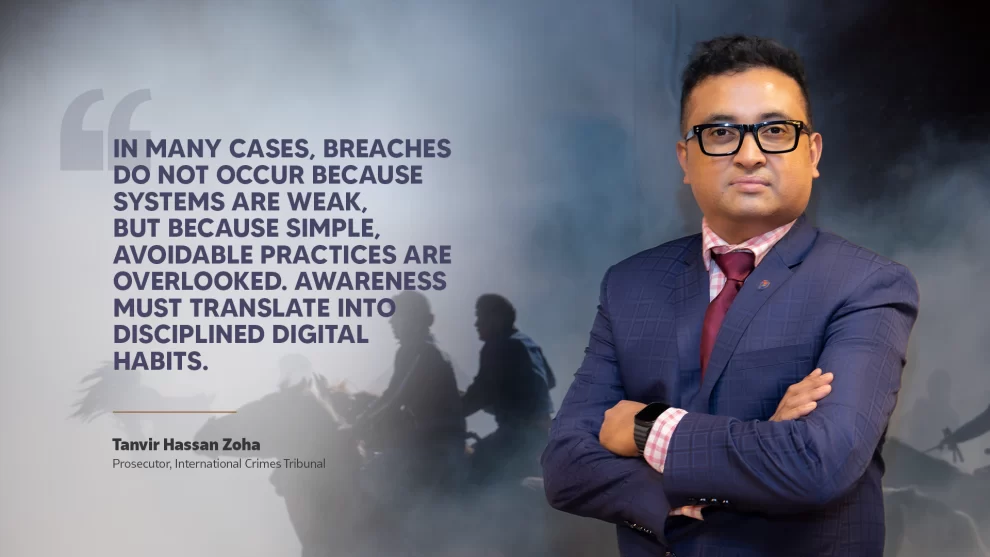
In many cases, breaches do not occur because systems are weak, but because simple, avoidable practices are overlooked. Awareness must translate into disciplined digital habits.

10. Looking ahead 10 years, do you believe Bangladesh can become a serious regional player in cybersecurity? What must change for that to happen?
Yes—provided there is strategic investment and coordinated policy development. Bangladesh has strong technical talent and a rapidly expanding digital economy. If we align our legal frameworks with international standards, strengthen public–private collaboration, and invest in research and human capital, we can emerge as a credible regional contributor in cybersecurity governance.
The next decade will favor nations that treat digital resilience not as a technical afterthought, but as a matter of sovereignty, economic stability, and the rule of law.