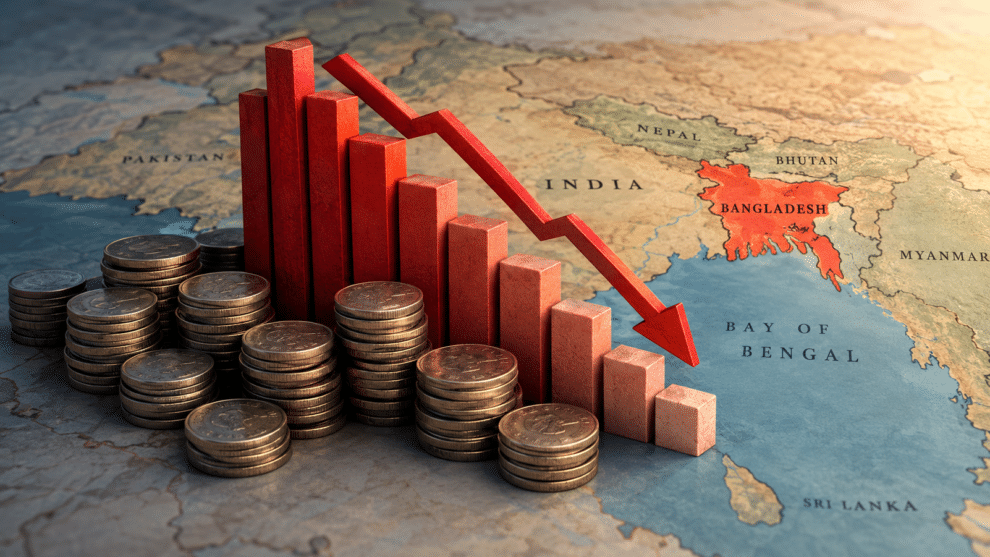
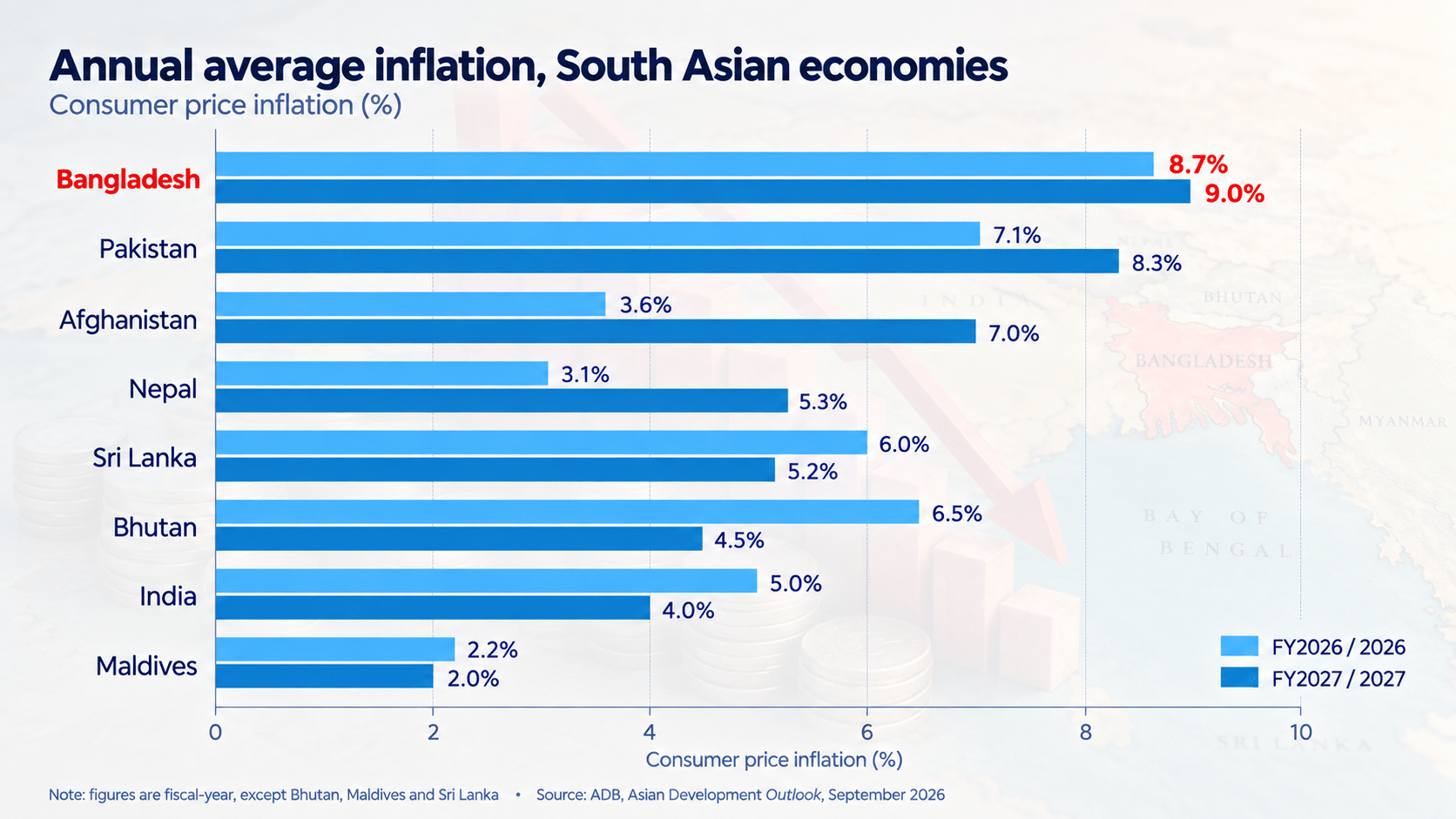
The Asian Development Bank’s Outlook, released on 23 September 2026, projects South Asia’s aggregate inflation easing to 5.5 percent this year and 4.8 percent next. Bangladesh moves against that current: 8.7 percent in FY2026, rising to 9.0 percent in FY2027, the only major economy in the subregion forecast to accelerate rather than settle.

A shared shock, an uneven landing
ADB traces the region’s price pressure to a common set of forces: a prolonged Middle East conflict keeping oil and freight costs elevated, a strong El Niño weighing on agriculture and hydropower, and intermittent shipping disruptions. Most economies are absorbing these shocks and moving toward disinflation. Bangladesh, heavily reliant on imported fuel and intermediate goods, has instead seen the costs transmit directly into domestic prices.
Where the domestic bottlenecks bite
Beneath the external shock, ADB points to structural constraints doing much of the work: unreliable electricity and gas supply raising production costs, recent retail fuel adjustments lifting transport and freight fares, and limited fertiliser access compounding El Niño’s effect on food output. These are supply-side frictions rather than a simple demand story, which is part of why they are proving persistent.
Growth gives ground as prices firm
The same report trims Bangladesh’s FY2027 growth forecast to 4.0 percent, down from 4.5 percent in July, while holding FY2026 growth at 3.7 percent. Slower growth alongside firmer inflation is the signature of a supply-shock economy: private consumption, cushioned by remittances, keeps carrying activity, while private investment stays subdued under banking-sector stress and costly credit. Public borrowing has continued to crowd into bank balance sheets, with credit to government up 30.4 percent year on year in June against just 4.5 percent private-sector credit growth.
A cautious easing, and a call for resilience
Bangladesh Bank has begun a gradual, less restrictive stance, trimming its repo rate from 10.0 to 9.5 percent in August. ADB frames this as appropriately measured given still-elevated inflation, and pairs it with a broader recommendation: strengthen macroeconomic management, financial-sector health, and energy security to buffer the economy against the next external shock, whatever form it takes.
“Bangladesh’s economy has begun to recover, but the process remains vulnerable to external shocks and internal constraints.”
—Remarks by Edimon Ginting, ADB Country Director for Bangladesh
Read together, the numbers describe less a policy failure than a structural exposure: an import-dependent, energy-constrained economy meeting a period of compounding global shocks. The reform agenda ADB outlines, on energy supply, bank balance sheets, and the business environment, is best read as the mechanism by which that exposure narrows over time.
Sources:
ADB, Asian Development Outlook, September 2026
ADB, South Asia ADO Supplement, September 2026
The Daily Star, ADB cuts Bangladesh growth forecast
UNB, ADB lowers Bangladesh’s growth forecast