1. Your journey spans Dhaka, higher education in the UK, and a career across accounting, investment banking, and advisory. Could you take us through your upbringing, academic journey, and the experiences that ultimately shaped your path as a Chartered Accountant and entrepreneur?
I am the product of three things: the way I was parented, the school that formed me, and the years I struggled through in the UK.
My parents set the foundation early. Discipline, honesty and a refusal to cut corners were never lectured at me, they were simply the standard of the house. Government Laboratory High School did the next part of the work; it teaches you to compete without teaching you to be cynical about it. From there I went to Notre Dame College, then to London Metropolitan University.
London made me, and not through its lectures. Life there was hard. I worked, I studied, and I learned what it means to be entirely responsible for yourself in a city that owes you nothing. I also saw a professional culture where documentation and independent judgement carry real weight.
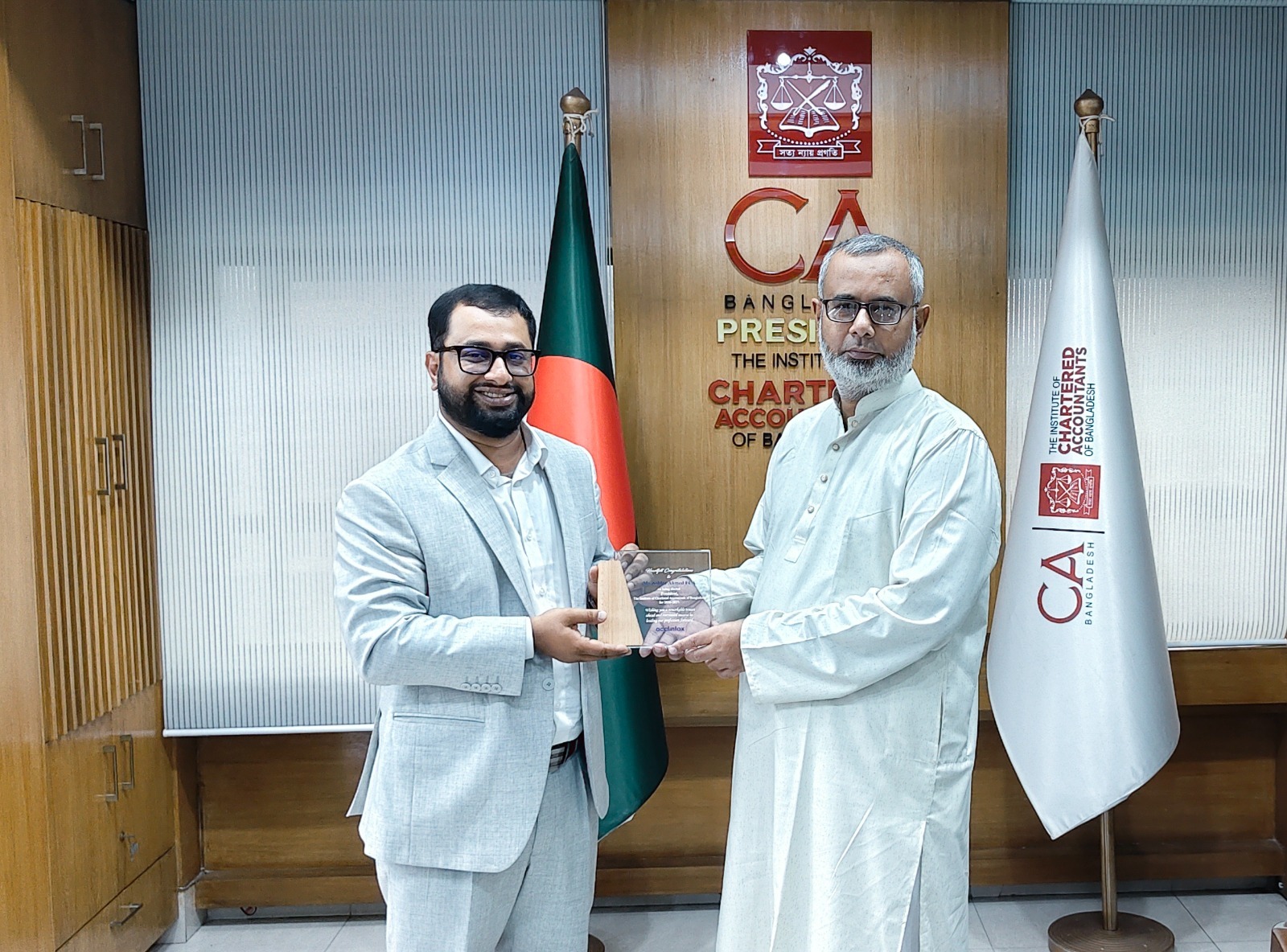
I returned in 2010 and joined Hoda Vasi Chowdhury & Co, working there full time until 2022 and rejoining as Associate Director in 2025. That firm was my real school in the economy of Bangladesh. My mentor there, Sabbir Ahmed FCA, now President of ICAB, moulded how I think and how I work, and I owe him a great deal. Alongside accounting engagements I gained exposure to equity management and investment banking, which gave me three views of the same company: how it reports, how it is valued, and how it is financed.
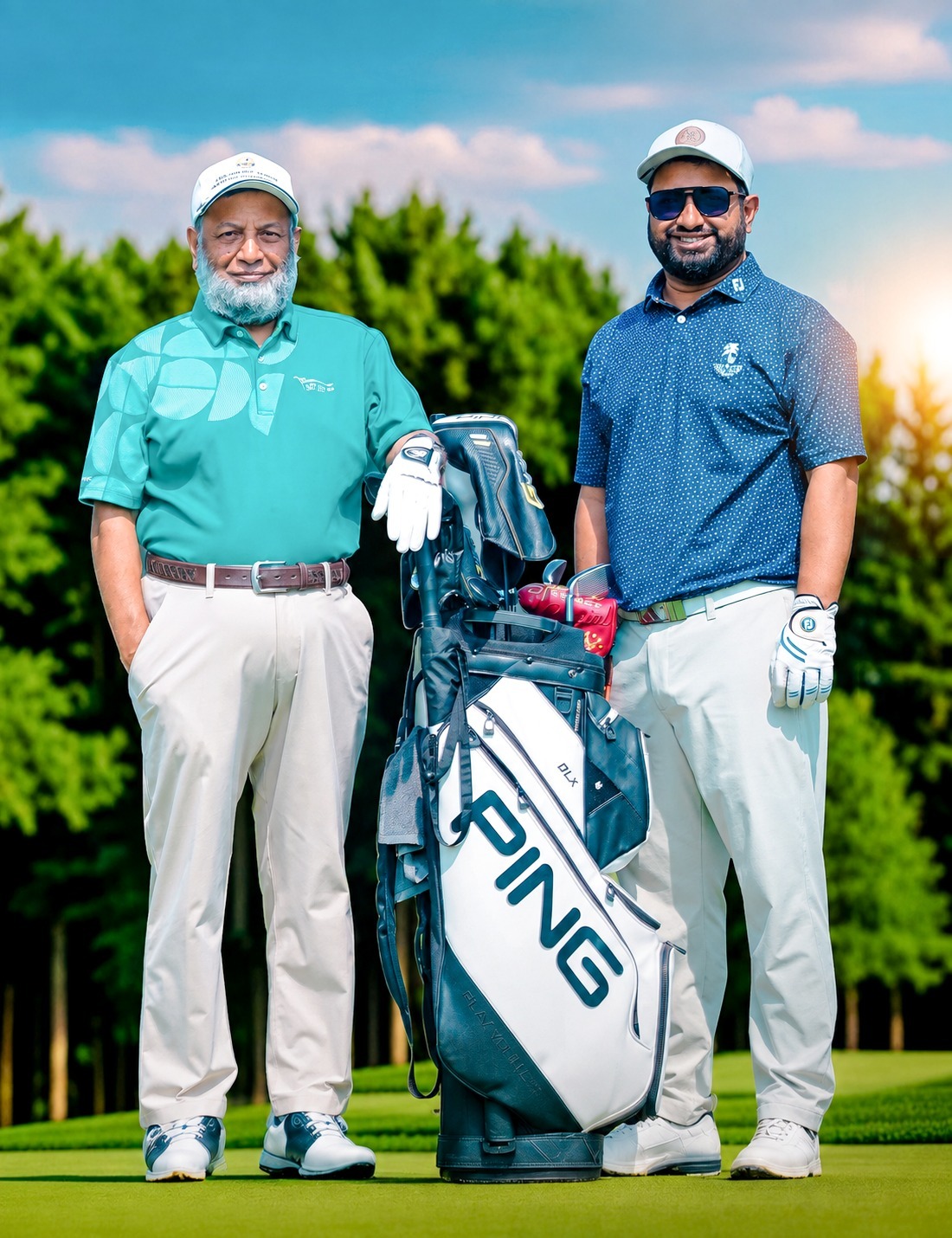
And there is my father, A F Nesaruddin FCA, Senior Partner at Hoda Vasi Chowdhury & Co and a former President of ICAB. I was never told to become a Chartered Accountant. I grew up watching what the work demands: precision, patience, and the willingness to say the uncomfortable thing. He also gave me golf. That example was never pressure, only proof that the standard was achievable.

2. Before founding Accfintax, you worked across accounting, equity management, investment banking, and professional practice. What gaps did you identify in Bangladesh’s advisory market that inspired Accfintax, and how has that thinking shaped the integrated firm it has become today?
The beginning was not a grand strategic vision. It started with diapers. I had a young son, I needed additional income, and I reached out to my friend Faisal Mahmud Sajeeb FCA. He introduced me to Mezarul Musrufe Ontu, and we started something small around personal tax returns. It failed. But it taught us how we worked together, which proved worth more than the venture.
Most people prefer a secure route into entrepreneurship. I wanted to grow. So in 2017 the firm was founded by three of us, Ontu, Sajeeb and myself, with Ontu and I taking the helm initially. We decided to name it Accfintax, with a simple idea behind it: a one stop solution for accounting, finance and tax, built on compliance, convenience and performance. I started as CEO and Ontu as COO, and I will always be grateful to him for his trust, his constant support, and above all for tolerating my speed and my crazier ideas.
The gap was structural. Listed companies and multinationals gravitate towards the Big 4, and rightly so. Beneath that tier sits the real engine of this economy: local groups and SMEs who need the same quality of governance, structuring, valuation and reporting discipline at a price that makes commercial sense. The second problem was fragmentation: one firm for audit, another for tax, a consultant for the plan, an intermediary for fundraising. Nobody owned the whole picture, so tax positions contradicting the financials and structures unravelled the moment they met due diligence. That is why everything at Accfintax sits under one roof, on the same facts and the same standard of care.
3. Accfintax’s expansion into Dubai represents an important step for a Bangladeshi-origin professional advisory firm. What drove that international expansion, and what will it take for more Bangladeshi professional-services firms to build credibility and compete across international markets?
We went to Dubai in 2023, when the UAE was introducing corporate tax. Almost every country already has an income tax regime in place. To watch one being enacted, from the drafting through to the first filings, is a once in a lifetime professional experience. I saw the opportunity and took a leap of faith.
It was also where we exposed ourselves to multinational clients, serving them on taxation and BPO mandates. That work is demanding, and it lifts the standard of everything we do at home. Alongside it sits a large Bangladeshi business community in the UAE now navigating TRN registration, VAT returns and corporate tax for the first time. When we launched formally in May 2025 with sessions in Abu Dhabi and Dubai, the rooms were full and the questions serious.
Today we run fully established offices in Bangladesh and the UAE, and serve clients in the United States, Canada, the United Kingdom, Singapore and Hong Kong through partner organisations and outsourced teams. For Bangladeshi firms to compete abroad, three things are needed. Quality must be demonstrable through qualifications, engagement quality control and a track record that withstands scrutiny. Firms must build institutional depth rather than remaining personality driven, because global clients buy the firm, not the founder. And we must compete on judgement rather than price. Cost arbitrage wins an engagement; it does not build a reputation.
4. From financial institutions and capital markets to manufacturing, infrastructure, startups, and e-commerce, you have advised businesses across very different sectors. What recurring weaknesses do you see in the way Bangladeshi companies approach governance, financial discipline, and long-term planning?
Three patterns repeat across almost every sector I have worked in, from banking and telecom to pharmaceuticals, real estate, infrastructure and startups.
First, ownership and management are not separated. In family enterprises, which is most of our private sector, the board is often ceremonial, related party transactions are undocumented, and decisions that should be institutional remain personal.
Second, reporting is treated as a compliance chore rather than a management tool. Many companies effectively maintain parallel views of their own numbers, one for the bank, one for the tax authority, one for the owner. It works until a serious investor arrives, at which point it becomes an unbridgeable credibility problem.
Third, planning horizons are extremely short. Businesses run cycle to cycle, with no scenario planning, no capital structure strategy, no succession plan. The cost stays invisible until a currency shock, a policy change or an energy disruption exposes it. The companies that have grown well here professionalised early, with real boards and numbers they stand behind.
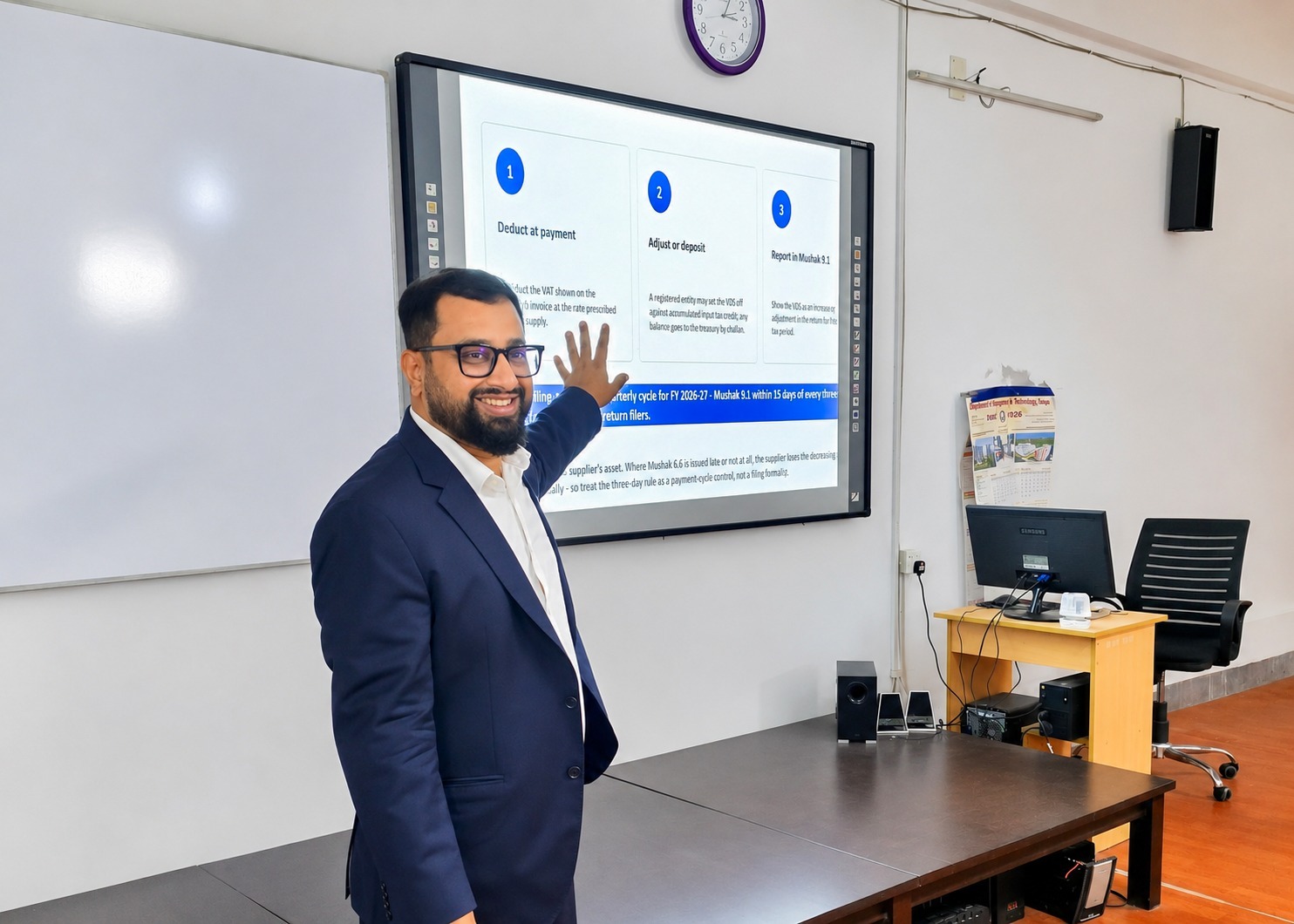
5. Access to capital remains a major challenge for many Bangladeshi businesses, while companies continue to rely heavily on traditional bank financing. From your experience in fundraising, valuation, and restructuring, what needs to change for businesses to access more diverse and sustainable sources of capital?
The constraint is not only the supply of capital. It is the supply of investable businesses.
Banks lend against collateral and relationships rather than cash flows, which suits neither high growth nor asset light companies. Meanwhile the corporate bond market is negligible, private equity remains thin, and the equity market has struggled to attract quality issuers.
On the market side we need a functioning bond market with genuine price discovery, a credible rating culture, deeper participation from insurance and pension pools, and a listing environment where good companies see the public market as an opportunity rather than an exposure. Predictability matters more than any single incentive, because investors price uncertainty harshly.
On the company side, capital has preconditions: reliable audited statements, clean structures, transparent related party dealings, and management willing to be accountable to outside shareholders. In our fundraising and restructuring work, deals rarely fail on business fundamentals. They fail on documentation, governance, and the discovery that the numbers cannot be substantiated.
6. Bangladesh’s businesses are navigating regulatory complexity, tax and VAT reforms, tighter financing conditions, and growing expectations around transparency. From an advisor’s perspective, which reforms are now most critical to improving the business environment and strengthening investor confidence?
Simplification, stability and predictability, in that order.
The direction of travel is right. The tax system is moving towards a data driven culture, with TIN and BIN linked to bank accounts, loans, utilities and trade licences. But the burden must fall somewhere reasonable. Multiple filings, overlapping withholding obligations and appeals with pre-deposit requirements consume disproportionate management time. Minimum tax on gross receipts, payable even in loss making years, remains a real problem in a downturn.
Rates matter less than reach. Lower, simpler rates on a wider net will collect more over time than high rates on a narrow base; most economic units here still have no TIN at all. That means simplified registration, plain language guidance, a single online portal, and refunds that arrive on time. Audit selection should be automated and risk based, with criteria published in advance. Where discretion goes, harassment goes with it.
We also need faster dispute resolution. And the binding constraint is often not tax at all. Ask a factory owner in Gazipur what keeps him awake and he will say gas pressure. Energy reliability is investor confidence.
7. Technology and AI are beginning to reshape accounting, audit, compliance, and financial decision-making. How do you see the role of Chartered Accountants and corporate advisors changing, and which capabilities will become more valuable as routine financial work becomes increasingly automated?
Automation will absorb the mechanical layer, meaning data entry, reconciliation, routine compliance and first pass review, and it should. That was never where the value sat, only where the hours sat. The exposure is only for those whose proposition was the hours.
What becomes more valuable is judgement in ambiguity. Interpreting a regulation where the answer is unsettled. Choosing a valuation assumption when there are no comparables. Designing controls for a business that has never had any. Telling a client something they do not want to hear. Machines process what has happened; they are weak at deciding what should happen next, and they cannot carry professional responsibility.
Three capabilities will matter: data and systems literacy, real commercial understanding of the client’s business, and ethics. We invested in technology early at Accfintax so our people work at the judgement layer rather than the keystroke layer. As financial information becomes cheaper to produce and easier to manipulate, a professional willing to attest to it becomes more valuable, not less.
8. On a lighter note, your profession revolves around numbers, valuations, risks, and projections. If you could put a value on one thing in life that no balance sheet could ever properly measure, what would it be?
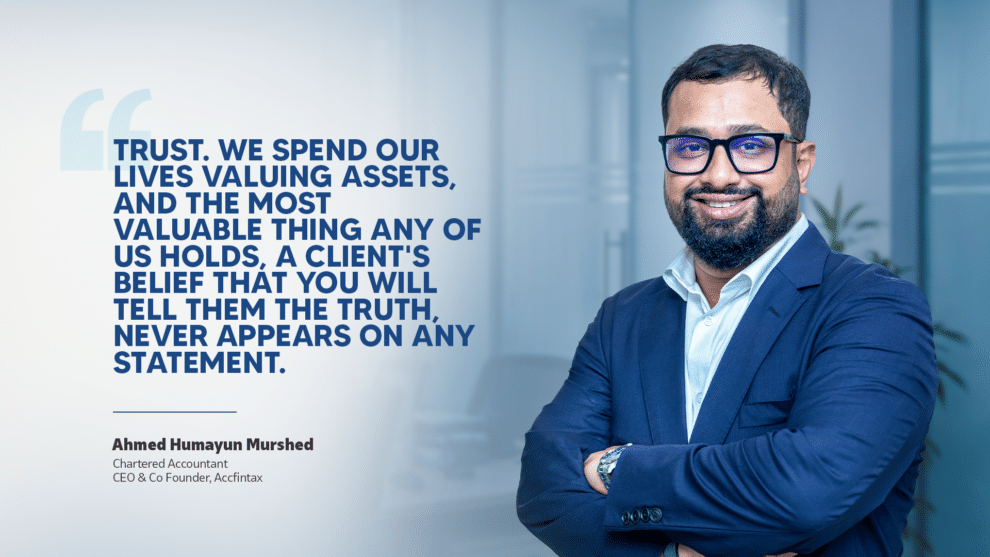
Trust. We spend our lives valuing assets, and the most valuable thing any of us holds, a client’s belief that you will tell them the truth, never appears on any statement. It takes decades to build and can be written off in a single decision.
Golf taught me something similar. My father would wake me before sunrise and take me to the course; at first I was only tagging along. Kurmitola Golf Club is my home, with two hole-in-ones there, and I have been fortunate enough to play in the UK, the UAE, Canada and Vietnam. But the lesson was never the scorecard. Golf is a game of controlling three things: fear, anger and greed. Nobody is watching your ball in the rough, so you call your own penalty or you do not. A person with real command of those three vices can be trusted, and no balance sheet will ever recognise it.
9. You have built a career across professional practice, entrepreneurship, advisory, and economic commentary. Looking ahead, what is your larger vision for Accfintax, and what kind of institution would you ultimately like it to become?
The first venture failed and the second began over diapers, so I have never pretended this was risk free. I would take the same risk again. I enjoy the work itself. Money is a consequence, not the objective.
I want Accfintax to become an institution rather than a firm, something that outlives its founders. That means depth of talent, systems and standards that do not depend on any one individual, and a culture where quality is defended even when it costs us an engagement.
I want us to be the firm Bangladeshi businesses turn to at the moments that matter: raising capital, restructuring, professionalising, listing, or expanding across borders. I would like our present reach to become a genuine regional practice headquartered here, serving South Asia and the Gulf. Proof that a Bangladeshi-origin firm can meet international standards without relocating its identity.
Beyond that, I hope we keep developing young professionals, contributing honestly to economic debate, and bringing golf to students at schools like Government Laboratory and Notre Dame.