1. You’ve served Bangladesh with distinction in the military and now lead its Olympic ambitions. What values from your years in uniform shape the way you guide the Bangladesh Olympic Association today?
My years in the military instilled in me core values like discipline, honesty, integrity, commitment and above all team teamwork. These values are my guiding force to work as the Director General of Bangladesh Olympic Association. My endeavour is to create an environment of professionalism in sports arena which will develop and promote sports with a view to developing and protecting the Olympic Movement in Bangladesh in collaboration with all stakeholders.

2. Many say sports development requires the same discipline and strategy as national defence. How do you see these principles overlapping when it comes to grooming athletes for the global stage?
Of course, there is a similarity between National Defence and sports development in terms of discipline and strategy. Both requires meticulous planning, programmed training and strategic execution. Athletes like soldiers must be nurtured through structured system, high performance training and psychological preparation. There should be a perspective plan with definite objectives to make athletes physically capable, mentally resilient and technically proficient. Regular evaluation is a must to ensure that athletes are continuously progressing and can compete globally with high morale.
3. Bangladesh’s sporting talent often shines in isolated moments but struggles to sustain success. From a systems perspective, what foundational weaknesses need urgent reform?
Most of the athletes of Bangladesh are God-gifted where a very few of them are made. We lack vision and long-term athlete development pathway. Urgent reforms are required in infrastructure, training and coaching standard and financial stability for the federations. Additionally, fostering a culture of Excellence, Professionalism and Good Governance within sports organizations will be very essential to achieve desired success in the international competitions.
4. Grassroots talent development is often where national pipelines break down. Under your leadership, what practical steps are being taken to identify and support promising young athletes in all corners of the country?
We are closely working with different National Federations, District and Divisional Sports Associations, schools, etc. to build an inclusive pipeline. Efforts are taken for nationwide talent hunts programmes to identify and nurture young potential athletes. We are organizing workshops &seminars to provide required tools and knowledge to the concerned stakeholders to develop talents in the rural and less developed areas of the country.
5. Funding remains a universal challenge for sports federations. How is the BOA exploring new partnerships or innovative financing to give our athletes world-class facilities and training?
While government funding remains limited, we are actively pursuing corporate sponsorships, public-private partnerships and international grant programmes. We are also improving our marketing strategy to position Sport as a platform of National pride and corporate visibility. The proposed ‘Olympic Complex’ at Trishal, Mymensingh is one of such initiatives that aims to attract sustainable investment in sport infrastructure.
6. Our performance in regional competitions like the South Asian Games can be a good barometer. What have these results shown you about Bangladesh’s readiness — and gaps — for the next Olympic cycle?
Our performance in the regional competitions reflects both potentials and weaknesses. We have to go a long way to prove our worth. Although we have prospects in Archery, Shooting and Cricket but other games lack depth and preparation in terms of psychological, physiological and perceptional measures. We need to narrow down our focus to specific sport to convert regional success into global competitions.
7. You bring a strong background in governance and institutional discipline. How are you applying that to ensure greater transparency, accountability, and efficiency within BOA’s operations?
Transparency and accountability are a must for an effective organization like Bangladesh Olympic Association. We have begun streamlining our work with clear documentation, digitalization and policy-based decision making. Performance based evaluation is our priority. Necessary steps are taken to review our existing statute and update policies with a view to bringing order in the system. We are making our people aware of their job to ensure justice in BOA’s operations.
8. On a lighter note, after years of service in uniform and now in sports administration — what keeps you personally motivated and inspired when the challenges feel overwhelming?
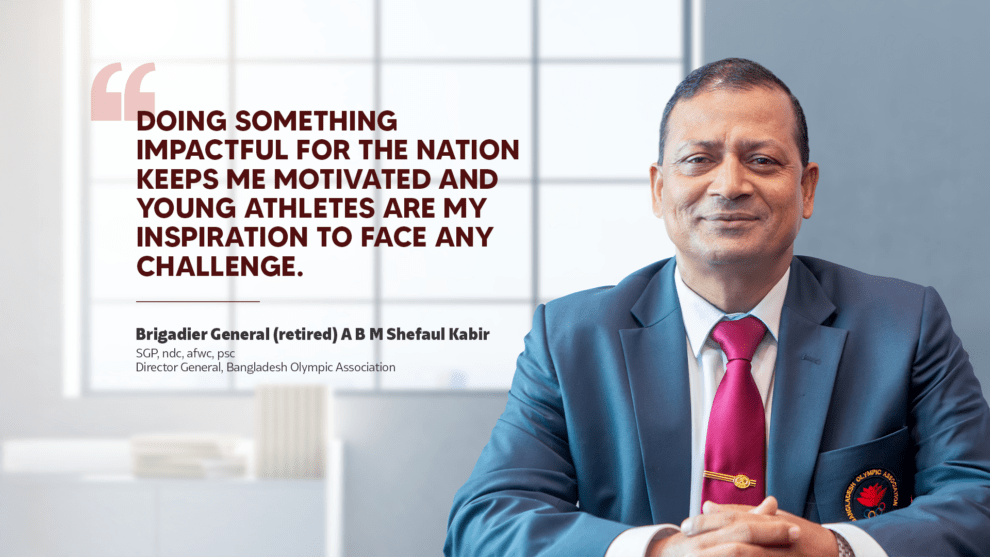
Serving the nation whether in uniform or in sport is my lifelong commitment. I am a sport enthusiast and an optimistic personality. I carry a strong passion for sports. Opportunity in serving BOA gives an honour and privilege to deliver the best of my ability for the development and promotion of sports in Bangladesh. However, doing something impactful for the nation keeps me motivated and young athletes are my inspiration to face any challenge.
9. Looking ahead, what is your dream for Bangladesh’s Olympic movement? What would you like your leadership to be remembered for — not just by the athletes, but by the nation?
My dream is to see Bangladesh emerge as a competitive nation in the Olympic Games and achieve medals. I aim to develop a system in place that can sustain such achievements. I want to be remembered for my commitment and professionalism in laying down a solid foundation where Olympic movement in Bangladesh is deeply rooted with integrity, inclusivity and sustained growth. This will benefit not only the athletes but also the nation in future.